
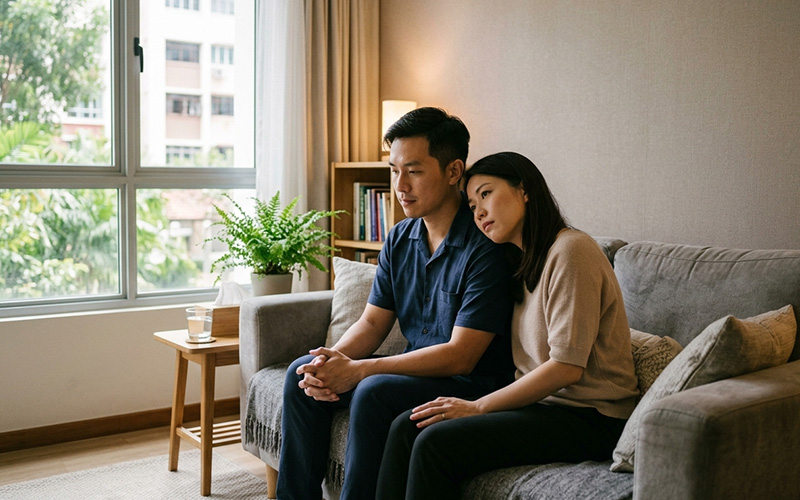
Most couples come to marriage counselling when something has broken down. Perhaps the same argument keeps surfacing with no resolution in sight. Perhaps there is a quiet emotional distance that neither partner knows how to close. Perhaps trust has been shaken in a way that feels very hard to come back from.
These are completely valid reasons to reach out for support. As reported by Channel NewsAsia, the number of marriages registered in Singapore fell by 7% in 2024, while the number of marriages ending in dissolution rose by 3.7% to 7,382 cases. While these numbers do not tell the full story of each couple’s experience, they do reflect the very real challenges many marriages face, and how meaningful it is that support is within reach.
What many couples discover, often to their own surprise, is that the benefits of marriage counselling extend far beyond addressing the problem that they first brought in. When two people commit to showing up honestly and doing the work together, they often grow through the counselling and therapy journey far more than they expected: a deeper understanding of themselves and each other, a renewed closeness with their partner, a relationship stronger than before, and the skills to continue to nurture the relationship beyond the counselling journey.
Here, we explore nine benefits of marriage counselling, including a few you might not have anticipated.
The 9 Benefits of Marriage Counselling
1. Improved Communication

One of the most immediate and lasting benefits of marriage counselling is learning how to communicate in a way that actually reaches your partner.
Many couples are not failing to talk. They are failing to truly convey what they really want to communicate or struggling to listen deeply to the other. In counselling, you and your spouse learn to express what you feel with greater honesty and clarity, and to listen in a way that improves mutual understanding.
Research published by Psychology Today highlights that couples who communicate more positively, using warmth, humour, and empathy, find it significantly easier to approach difficult issues constructively. Relationship researcher John Gottman’s work also shows that couples in satisfying relationships maintain roughly five positive exchanges for every difficult one.
At In Focus, our work with couples is informed by Emotionally Focused Couple Therapy (EFCT) and Choice Theory Reality Therapy (CTRT), alongside other complementary approaches based on systemic therapy. These methods help couples identify unhelpful patterns of interaction and build healthier ways of connecting, not just in the session, but in their day-to-day life together.
You can read more in our article on Couples Counselling: Strengthening Communication and Understanding for a Healthy Relationship, and explore practical steps in How to Improve Communication with Your Partner: 7 Ways to Rebuild Connection.
2. Understanding the Root of Your Conflicts

It can feel like you and your partner are going around in circles, arguing about the same things over and over. One of the more unexpected gifts of marriage counselling is discovering that most recurring conflicts are rarely about the surface issue at all.
Underneath arguments about money, parenting, or how each partner is spending their time , there are often unmet emotional needs, old hurts, and long-held beliefs or behaviour that neither partner is fully conscious of . When you begin to understand what is really driving the tension, you are in a much better position to address it, rather than simply managing the symptoms each time they surface.
This process of guiding clients in being able to go deeper is the value the In Focus team brings to counselling and therapy. . Our approach is person-centred and humanistic, which means we respect that every individual is different and innately desire to grow towards their potential. . We help you better understand yourself so as to help you also show up more authentically with your partner who will then know you better. At the same time, being authentic may bring up feelings of vulnerability that you may not feel prepared for, thus couples counselling and therapy at In Focus is the place where such conversations and interactions are facilitated in a manner that is emotionally safe.
3. Rebuilding Trust

Whether trust has been broken through betrayal, dishonesty, or longstanding recurring experiences of feeling let down by each other, rebuilding it takes time, honesty, and the right kind of support.
Marriage counselling provides a structured, non-judgemental, impartial space to address what happened, not to assign blame, but to help both partners understand each other’s experience, the impact of what occurred, and to heal from it to move forward.
The American Psychological Association notes that couples therapy has a strong evidence base for helping couples move through relationship distress, including situations involving significant breaches of trust.
At In Focus, we believe that with the right support and a willingness to put in consistent hard work by both parties, it is possible to restore trust. In many cases, couples find that the relationship becomes more intentional and more resilient than it was before, because they have confronted the challenges in the relationship head on rather than avoiding or denying they exist.
4. Reconnecting Emotionally

It is entirely common for emotional closeness to fade over time, especially in a long marriage. Life, stress, parenting, and competing demands can gradually push couples into a kind of comfortable parallel living, sharing a home without truly sharing themselves.
One of the most meaningful benefits of marriage counselling is the opportunity to rediscover your emotional connection with your partner and re-establish the life you want with each other. This is not about returning to the early days of a relationship. It is about building something compatible with where you both are in the current season and the closeness that comes from knowing and accepting each other as you truly are right now.
If emotional distance has been a concern in your relationship, our Marriage and Couple Counselling page shares more about how counselling can help couples work towards renewed connection and meaning together.
5. Growing as an Individual Within the Relationship

This is one of the benefits of marriage counselling that many couples do not anticipate. In working to understand your relationship, you will inevitably come to understand yourself more deeply, too.
You may begin to see how experiences and choices in your younger years influence how you have been responding to your partner. You may gain a clearer sense of what you truly need, what matters most to you, and where your own growth edges lie, while still being committed to your relationship. This kind of self-awareness does not pull you away from your partner, but helps you live an even fuller life, even if it means re-negotiating the current dynamic in the relationship.
At In Focus, we are committed to an approach that is empowering, not prescriptive. We do not tell you what to do or what to value. We ask questions that promote deeper thinking about the self and hold space for you to explore who you are, because we believe that lasting change comes from within.
6. Making Important Decisions Together

Couples often make significant decisions in their couple life: whether to start a family, how to manage finances, whether one should make a particular career move, how to care for ageing parents, or what to do when they feel like they are growing apart. When communication is strained or emotional distance has grown, these discussions become further moments of tension rather than moments of bonding through a shared challenge.
Marriage counselling helps couples approach these moments with greater clarity and mutual respect. With a counsellor present to facilitate the conversation, both partners have the space to share what they truly feel and think, and to hear each other more deeply despite existing tensions in the relationship.
At In Focus, our sessions are held weekly or fortnightly, with regular reviews to ensure the work remains aligned with what both partners are hoping to work towards. This continuity matters, as it means there is consistent and grounded support for the process of change and growth even as challenges arise along the way. The pace and focus of our work is always collaborative, focusing on your goals and what is relevant in this season of your relationship.
7. Developing Emotional Regulation Skills

When emotions run high in a relationship, it can become very difficult to think clearly, respond thoughtfully, or hear what your partner is actually trying to say. Learning to understand and regulate your own emotional responses is one of the most practical and lasting benefits of marriage counselling.
In sessions at In Focus, couples are supported in recognising how they experience and express their emotions, and in developing the capacity to stay present and grounded even in difficult moments. This is not about suppressing feelings. It is about understanding them, holding them with greater ease, and being able to choose how you respond, rather than reacting in ways you later regret.
The American Psychological Association notes that emotionally focused approaches to couples therapy show strong outcomes for couples experiencing distress, with lasting improvements in relationship satisfaction.
8. Building Skills That Last Beyond the Counselling Room

The changes that emerge through marriage counselling are not confined to the sessions. The communication skills, the self-awareness, the ability to navigate conflict with greater care: these become part of how you and your partner relate to each other every day.
At In Focus, we have always believed that counselling is not meant to be a permanent arrangement. Our goal is to empower you to eventually be independent and able to apply what you have learnt. Sessions are paced with this in mind. We work alongside you, and as you grow in strength and capability, we step back in a way that supports your independence rather than your continued reliance on us.
The skills you build in marriage counselling also extend well beyond your relationship. Many clients find they become better communicators at work, more patient as parents or as adult children to their parents and more self-aware across all areas of their life.
9. Strengthening Intimacy

The changes that emerge through marriage counselling are not confined to the sessions. The communication skills, the self-awareness, the ability to navigate conflict with greater care: these become part of how you and your partner relate to each other every day.
At In Focus, we have always believed that counselling is not meant to be a permanent arrangement. Our goal is to empower you to eventually be independent and able to apply what you have learnt. Sessions are paced with this in mind. We work alongside you, and as you grow in strength and capability, we step back in a way that supports your independence rather than your continued reliance on us.
The skills you build in marriage counselling also extend well beyond your relationship. Many clients find they become better communicators at work, more patient as parents or as adult children to their parents and more self-aware across all areas of their life.
Marriage Counselling Is Not Just for Crisis

It is worth saying clearly: you do not have to be in crisis to benefit from marriage counselling. Many couples seek support as a way of growing together, deepening their connection, strengthening their communication, or navigating a life transition together. They recognise that it does not have to wait for something to go wrong to begin. Rather they value what they have and want to invest in it for their future.
Whether you are, newly married, have been together for decades, or are navigating a specific challenge in your relationship at this moment, marriage counselling offers a supported space to grow together.
Begin With a Complimentary Call
At In Focus, we understand that reaching out for support is not always easy. That is why we offer a complimentary initial call before any session is booked.
During this call, we take the time to understand your situation, share a little about how we work, and explore whether we are the right fit for your needs. There is no pressure and no commitment required. It is simply a conversation, one that allows us to begin with mutual understanding and care.
Our counsellors are registered with the Singapore Association for Counselling and hold Master’s degrees in counselling or related fields. Our work with couples is grounded in Emotionally Focused Couple Therapy (EFCT) and Choice Theory Reality Therapy (CTRT), and is informed by systemic theory, attachment theory and neuroscience. When you are ready, we invite you to get in touch with us to speak with our counsellors and take that step in moving forward with your partner.