

“I love my parents, but I dread talking to them, it often ends the same way… they think they are always right and there is no room for my point of view. No point talking.”
This is something many adults in Singapore carry quietly, sometimes for years. The tension is real, the exhaustion is real, and yet there is often a layer of guilt and it can be hard to speak about it openly. After all, the conventional belief is “Family is family. You are supposed to get along. You are not supposed to talk about your disagreements.”
But getting along and staying close does not come naturally, even in families where there is genuine love and appreciation for our parents. For many people, the relationship with their parents is one of the most complicated they will ever navigate – full of history, unspoken expectations, and patterns that have built up over a lifetime. And for a growing number of adults in Singapore, this is not just a background ache but something affecting their emotional wellbeing, their confidence, and their daily life.
If you find yourself in this space, you are not alone, and there is real support available to help you move forward.
Why Parent-Child Relationships Can Feel So Difficult Even in Adult Years
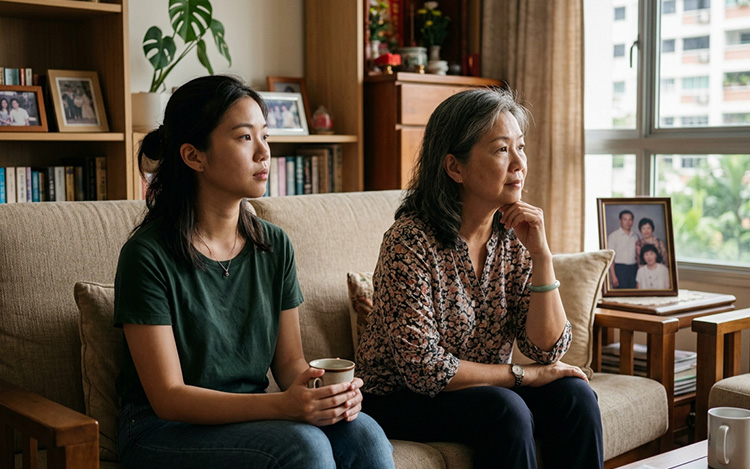
The parent-child relationship is unlike any other. It begins before we have any say in it as a child. A relationship with a significant adult figure in our childhood years impacts the way we see ourselves and the world. This relationship continues to evolve long after childhood ends. By the time we reach adulthood, we would have our own unique experience of this relationship – from one of deep connection and shared experiences to one fraught with challenges and its share of strain. Research on intergenerational relationships shows that tensions between parents and adult children are common and often centre on the quality of communication itself, not just the specific topics of disagreement. In other words, it is often not what you argue about, but the way both parties relate to each other that creates the most distance. When conversations repeatedly end in frustration, withdrawal, or conflict, and when attempts to connect seem to widen the distance rather than close it, the relationship can start to feel like something to keep at bay rather than to grow and nurture.
In Singapore’s cultural context, this is further influenced by the values of filial piety and its interpretation. Often, the expectation seems to be that children are to show respect, deference, and care for their parents in certain ways. These values are deeply held and meaningful. And yet, as Professor Paulin Straughan (SMU) has noted, traditional expressions of filial piety have become increasingly complex to sustain as families grow smaller, people live longer, and the values of younger generations continue to evolve. When the gap between what a parent expects and what an adult child is able or willing to give grows wider, it can generate tension on both sides, even when both parties care deeply about the other.
Recognising When You Are Feeling The Strain of The Relationship

There is a difference between the occasional disagreement that most families experience, versus a prolonged pattern of relating where the child feels unseen, misunderstood, or emotionally depleted relating with a parent even as an adult. The latter often warrants closer attention.
You might recognise some of the following in your own experience. Perhaps interactions with one or both of your parents frequently leave you feeling anxious, guilty, or flat, regardless of how the conversation started. You might notice that you hold back or monitor yourself carefully around them, finding it hard to speak freely about your life, your choices, or how you are feeling. Some people describe a sense of never quite being able to meet their parent’s expectations, however hard they try, and instead often feel attacked or small. Others find it hard to know where your parent’s needs end and your own begin.
For some, this may stem from experiences earlier in life, coming from what were not addressed back then but continue to affect how they relate to the parent today. When there is an unresolved past, even when the child tries to keep a distance day-to-day, tension and unease that remains in the relationship may quickly come back to the surface during interactions.
Singapore’s National Youth Mental Health Study (2024), conducted by the Institute of Mental Health, found that approximately 1 in 3 young people aged 15 to 35 reported severe or extremely severe levels of depression, anxiety, or stress. Family relationships were identified as one of the contributing factors, and difficult experiences in childhood were linked to more significant mental health difficulties. Notably, parents recognised signs of distress in their children only 10% of the time, reflecting how much remains unseen and unsaid between the two generations.
The Weight of Unspoken Expectations

One of the most common sources of strain in parent-child relationships even when the child has grown up is the gap between what is expected and what is communicated. Expectations around career choices, relationships, living arrangements, financial support, and how much time should be spent together are rarely discussed openly. They are more often felt through reactions, comments, silences, and the subtle but persistent sense that you have either met the mark or fallen short of it.
In recent years, this pressure has taken on new dimensions. The population aged 65 and above rose from 13.1% in 2015 to 20.7% in 2025, and by 2030, approximately 1 in 4 citizens will be in this age group. Families are smaller, with the total fertility rate in Singapore reaching a record low of 0.97 in 2024. This means that the caregiving responsibility increasingly falls to fewer adult children, often alongside demanding careers and their own family commitments.
For many adult children of parents who are getting on in years, there is often a genuine internal conflict. They want to care for their parents and honour the relationship. At the same time, they are navigating real limitations in what they can give, emotionally, financially, and practically. When this conflict goes unspoken, feelings of guilt, resentment, or a quiet sense of failure may build up. None of these help the relationship, and may instead work against both the relationship and individual well-being.
Research drawing on the Dual Filial Piety framework offers a useful distinction here. Filial care that is motivated by genuine love and gratitude tends to support emotional wellbeing on both sides. Filial care coming from a sense of obligation and a fear of disapproval tends to have the opposite effect. This is not a reason to step back from caring for your parents. It is, however, an invitation to explore what is underlying our experience of the relationship, and whether there is a more sustainable and emotionally honest way to be in it.
How Our Early Family Experiences Impact Us
Much of what we bring to our adult relationships, including our relationship with our parents, has its roots in how we learned to connect as children. The patterns we developed early in life around how we try to be close, how we deal with conflict, how we express our emotions and even how we see ourself, do not simply disappear when we grow up. These tendencies tend to continue unless we have become aware of them and intentionally made changes as adults in how we relate with the significant people in our life.
Research on attachment and adult relationships has found that people who experienced more conflict with their parents, less emotional closeness, or harsher parenting during childhood tend to feel less secure in their adult relationships, including their ongoing relationship with their parents. This is not about blame. Parents, too, bring their own histories to the relationship, their own experiences of being parented, their own unresolved losses, and their own ways of showing love that may or may not land the way they intend.
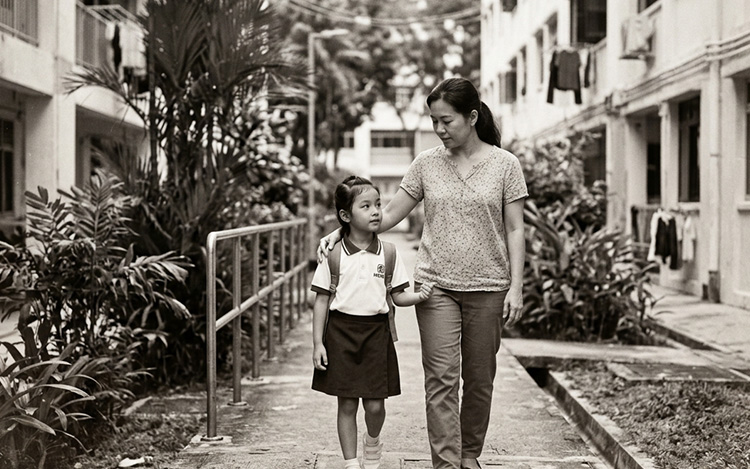
One of the more meaningful things that counselling and therapy can offer is uncovering the relationship patterns with significant people in our life, including our parents. When we begin to have greater clarity of the communication patterns with our family members, we better understand the present state of relationship with them and the options we have now. The ways of relating with each other are not fixed truths about who we are or how things have to be, but as ways that were learnt. This also means one can learn new ways or modify the current ways of relating. The relationship with our parents can continue to evolve as a result. At the same time, the parts of the self that developed with our growing up experiences in the family can also evolve and we can make new choices to be coherent with the person we want to be without cutting off relationships that matter to us.
If You're the One Reaching Out

In our experience of working with clients, it is often the adult child who reaches out first. This is true whether the difficulty involves a parent who is critical or emotionally distant, a parent who struggles to see their child as an independent adult, a relationship where old hurts have never been healed, or a dynamic that feels exhausting to maintain.
Coming to counselling and therapy as an individual to address a family relationship is not a sign that the problem is yours alone. It is a recognition that you can start with yourself, and that is where change begins.
Individual counselling and therapy offers a space to make sense of what you are feeling in the relationship, including the feelings that may seem contradictory such as, love alongside frustration, loyalty alongside resentment, a longing for closeness alongside a need for space. It supports you in developing greater clarity about what you want in the relationship and what you are finding challenging. It also helps you build the emotional and communication skills to engage differently, not to fix or change the other person, but to relate in a way that is authentic and yet not destructive to the relationship.
For some clients, family counselling and therapy eventually becomes possible, where both the adult child and the parent come together to work through the relationship with the support of a counsellor or therapist. This can be a significant and often healing process, particularly where there are unresolved hurts on both sides and a genuine desire to improve the relationship. However, this is not always possible. Nonetheless, individual work can be just as significant and transformative over time.
What Counselling for Family Relationship Difficulties Can Offer

Counselling and therapy for parent-child relationships when the child is now an adult is not about learning to manage a difficult person. It is about understanding your own inner experience more fully and building the capacity to engage in the relationship in a way that feels authentic and sustainable.
In our work with clients navigating family difficulties, there are many significant areas of exploration. This includes understanding the patterns that have developed over time and where they came from, processing feelings that have not been expressed, clarifying personal values and what the relationship means to you, and developing the communication skills to express your needs and perspectives and feel heard in a respectful way.
Research consistently supports the effectiveness of family-focused therapeutic work, with family therapy shown to be as effective as or more effective than individual therapy for many relational difficulties. Even when only one family member participates, the work can shift long-standing patterns in meaningful ways.
At In Focus, our approach draws on Emotion Focused Therapy and Choice Theory & Reality Therapy. We help you learn to express your emotions and your experiences (even if it feels hard to access at the moment), as well as to be empowered to move forward in a responsible way in relationship. We work at the pace of your readiness as a client and always with your goals and wellbeing at the centre of the work.
There Is Hope for These Relationships

One of the most encouraging things we have seen in our work is that family relationships, even those that have been strained for a long time, can change. Relationships are hardly perfect nor uncomplicated, but improvements are always possible. That change often begins with one person deciding to look more closely at their own experience and start to change oneself, rather than waiting for the other to change first. It begins with a willingness to understand and make new choices, rather than just stay reacting based on habits and familiarity. If you recognise yourself in what has been described here, whether your difficulty involves a parent who is ageing, a relationship that has felt tense for years, unresolved experiences from your younger years, or a sense that things between you and your parent could be better than they are, we will be glad to hear from you and support you on the journey of change.
Taking the First Step

Counselling and therapy is an investment in your own mental health and wellbeing through addressing the challenges in the relationships that matter most to you. At In Focus, we offer a complimentary 20 to 30-minute initial call to hear about your situation and share how we work, so that we can get a sense together of whether we are a good fit for your journey.
You may also wish to explore our family therapy and counselling services to learn more about how we approach family relationship work. Whether you are a young adult navigating a difficult relationship with a parent, or a parent hoping to find a way back to connection with your adult child, we are here to support you.
Contact us today to begin.