

“I have tried everything. The breathing exercises, the to-do lists, the morning routines. But by Monday morning, it all comes back.”
If that sounds familiar, you are not alone. Work anxiety is one of the most common reasons people in Singapore seek counselling today, and it feels exhausting because it’s often hidden behind productivity, professionalism, and the appearance of having it together.
The anxiety does not always seem obvious. Sometimes it looks like lying awake on Sunday night replaying a conversation with your manager. Sometimes it is the low hum of dread before a team meeting, the compulsive re-checking of emails, or the gnawing sense that no matter how much effort you put in, it is never quite enough. Sometimes it manifests also as irritability at home, or a general feeling of numbness.
What many people find, after months or even years of trying to manage these feelings, is that coping strategies help in the moment but what is really driving the anxiety remains unaddressed.
The Scale of Work Anxiety in Singapore

Work-related stress and anxiety are prevalent experiences here. According to the ADP Research Institute’s “People at Work 2023” report, roughly two-thirds of employees in Singapore experience stress at least once a week, exceeding the regional average for Asia Pacific. Gallup’s State of the Global Workplace 2024 report placed Singapore third in Southeast Asia for daily workplace stress. ManpowerGroup’s Global Talent Barometer 2026, which surveyed 515 workers in Singapore, found that nearly three in five reported feeling burnt out, with stress and heavy workloads cited as the leading causes.
A study by Duke-NUS Medical School and the Institute of Mental Health, published in 2023 estimated that anxiety and depression cost the Singapore economy approximately S$15.7 billion annually, with the majority of losses attributed not to absenteeism but to people who are present at work but not truly functioning. Workers dealing with anxiety lose an estimated 64 productive days a year, yet many struggle with this in private. A study by TELUS Health found that nearly three-quarters of workers in Singapore fear their career may be affected if their workplace becomes aware of the difficulties affecting their mental health. In a culture where performance is highly visible and professional reputation highly valued, admitting that something is not right is often associated with significant risk professionally.
The Added Weight of AI Uncertainty
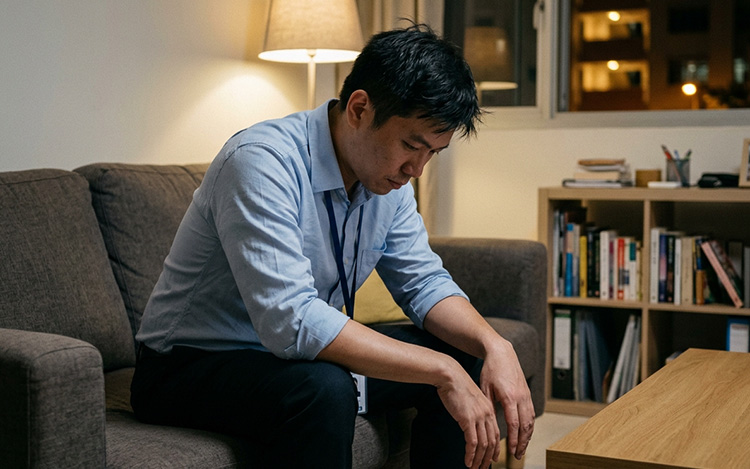
In recent years, a new layer of concern has compounded the feelings of workplace anxiety in Singapore. The rapid rise of artificial intelligence has introduced a kind of uncertainty and unease, particularly for those who have tied their sense of security closely to workplace performance and the perceived value of their skills.
In his Budget 2026 speech, Prime Minister Lawrence Wong acknowledged directly that while AI holds enormous promise, workers worry that AI will displace jobs. According to the ADP Research Institute’s “People at Work 2025” report, about one in five workers in Singapore remain uncertain about how AI will change their jobs, and those who fear being replaced are twice as likely to report high levels of stress at work. The uncertainty is felt most acutely among knowledge workers, whose roles depend on expertise and judgement, precisely the qualities that feel hardest to defend when a technology’s boundaries are still shifting.
For many people, this is not simply a practical worry about skills or job security. It touches something deeper: a question about worth, relevance, and what it means to do meaningful work. When those questions are already present beneath the surface, the fast pace of AI adoption can intensify work anxiety.
What Work Anxiety Can Look Like
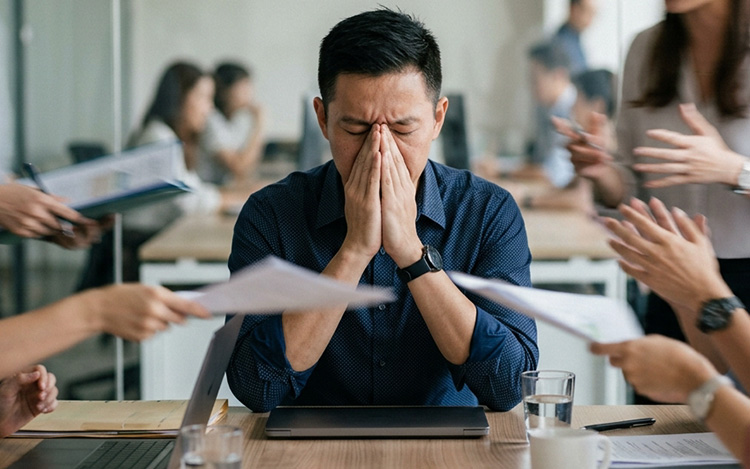
Work anxiety does not look the same for everyone. It often presents in one or more of the following patterns.
Anxiety about performance and progression is perhaps the most common. It shows up as a relentless pressure to prove yourself, a fear that you are not advancing quickly enough, or a nagging sense that you could lose what you have built if you make the wrong move. Some people describe feeling like they are always one step away from being found out that they are actually not good enough. A 2023 regional survey found that approximately 60% of working adults in Singapore had experienced these kinds of feelings, particularly younger professionals navigating the early stages of their careers.
Anxiety about how others perceive you at work is a quieter but equally consuming experience. It might mean spending a disproportionate amount of time re-reading a message before sending it, dreading presentations not because you are unprepared but because you cannot stop imagining how others will judge you. For some, it may mean saying “ok” or “yes” to every request to please others to the point of feeling overwhelmed, finding it hard to catch a break and even losing sight of one’s own needs. . Difficulty in managing interpersonal relationships and team dynamics is another source of anxiety at work. Conflict with a colleague or manager or tension and unpredictability in a team environment can be sources of stress that feels hard to shake off at the end of the work day. These are not character flaws or signs of weakness. They are understandable experiences and they deserve to be taken seriously.
When It Starts to Affect Your Relationships
One thing many people do not anticipate is how significantly work anxiety can affect life outside of work, particularly close relationships.
When you are carrying ongoing anxiety about your performance, your standing with colleagues, or your future at work, it is very difficult to fully switch off those feelings when home. You may be carrying the emotional weight of a tense day with you into conversations with your partner, your interactions with your children, or into the time spent with your friends. Inevitably, if nothing is done about it, it affects the quality of time out of work . Over time, those around you may notice that you seem distant, short-tempered, or simply not quite present, even when you are physically there.

When the internal resources needed to manage anxiety at work are depleted, there is simply less available for everything else. Couples may find their relationship more conflictual or distant, and less needs-satisfying than before when one or both partners experience anxiety arising from their workplace experiences.
If you recognise this pattern, it may be worth exploring not just the relational strain itself, but also the other contributory factors .
Why Coping Strategies Often Are Not Enough

There is real value in coping strategies. Breathing exercises, mindfulness practices, and time management tools can all be helpful ways to regulate the anxious feelings. We do not discount them.
However, there is a distinction between managing anxiety in the moment versus understanding what is driving it and addressing the core issues.
A major study by Oxford University, published in 2024, examined the wellbeing outcomes of over 46,000 employees across 233 organisations. After analysing 90 different workplace wellness interventions, from resilience training to mindfulness apps to sleep programmes, the researchers found that participants appeared no better off than those who had not participated. The study’s key conclusion was that interventions focused on managing individual symptoms, without addressing the deeper sources of strain, tend not to produce lasting change.
In other words, coping strategies can ease the pressure at the surface, but when the anxiety continues to resurface after a particular the stressor is over and you notice a this happening over and over in a particular pattern, there is value in going deeper to understand yourself and address those deeper issues through counselling and therapy. Some have come to realise through the exploratory process in counselling and therapy that they have long-held certain beliefs, such as seeing one’s value as dependent on performance, or insecurities such as a fear of being seen as inadequate, or particular ways of relating to authority that traces back well before the current workplace. Through the process of counselling and therapy, individuals have gone beyond coping skills to being able to address the underlying issues linked to the feelings of anxiety.
The Deeper Roots of Anxiety at Work

For some, the underlying anxiety did not start from the experiences at the workplace.
Fear of falling short, heightened awareness of others’ perceptions, difficulty asserting needs within a team – these are likely to have much earlier origins. They tend to develop in the environments where we first learned what it meant to belong, to be valued, and to feel safe. For many people, those environments included messages, sometimes spoken but more often unspoken, about the conditions to be met to feel loved, accepted, or valued.
When those early experiences are left unexamined, they do not disappear. They stay with us into our adult lives and become activated when the stakes feel high. For example, interactions with a particular manager may stir up something within that is not just about what is going on with this manager. The intense feelings that surface may come from earlier experiences that have now come to the surface.
This is not about looking backwards for the sake of it or to feel sorry for oneself. It is about developing a fuller understanding of yourself, and to become empowered to live the life you want and bring about lasting change.
What Counselling and Therapy Can Offer

Counselling and therapy for work anxiety is not only for learning coping techniques.. It can also be about creating a space to understand your internal experience more fully – the emotions beneath the anxiety, the beliefs that are sustaining it, and the current behaviours that may not be effective- and to learn more targeted ways to regulate the emotions and triggers as well as explore more effective ways of meeting your needs .In our work with clients who experience fear of judgement or feel immense pressure to perform, not only do we explore what the fear of judgment or the pressure to perform is really about,we also work towards developing a more compassionate and kinder relationship with themselves. In the course of it, potential mistakes and uncertainty not only become less overwhelming, but can even be taken as opportunities for growth in many ways that’s personally meaningful to the client.
At In Focus, our approach draws on Emotion Focused Therapy and Choice Theory and Reality Therapy. Emotion Focused Therapy helps clients connect with and make sense of the emotions beneath the anxiety, including feelings that may feel difficult to access or stay with. Choice Theory and Reality Therapy supports clients in exercising their personal agency in situations, reviewing choices made and exploring new choices available to them and move forward in concrete and practical ways that’s realistic for the client. Together, these approaches attend to both the emotional depth of the experience and the practical steps towards change.
Our sessions are collaborative, guided by your goals and paced according to your readiness. Our role is to help you develop the clarity, skills, and inner resources to navigate your life with greater ease. For some clients, individual counselling is the starting point. For others, particularly where work anxiety has significantly affected a close relationship, couples counselling alongside individual sessions may also be part of the journey.
There Is Hope

Change is possible. In our work with clients, we have seen clients growth towards greater confidence, clarity, and ease, not because their circumstances changed , but because they developed a different relationship with themselves and with the pressures they face.
If you have been managing work anxiety for some time and the strategies you rely on help you get through but do not quite reach the heart of it, that experience is worth paying attention to.
Taking the First Step
At In Focus, we offer a complimentary 20 to 30-minute initial call to hear about what you are going through and share how we work, so that we can get a sense together of whether we are a good fit for your journey.
If work anxiety has been affecting your daily life, your relationships, or your sense of yourself, we would be glad to hear from you.
Contact us today to begin.
You may also wish to explore our anxiety counselling and therapy services to learn more about how we approach this work.